"
We’re a city of artists; we’re a city of creatives. Being a City of Design means we recognise and value good design in its many forms. But more than that, it gives us the chance to evaluate how design impacts our lives, from the smallest details to the largest buildings.
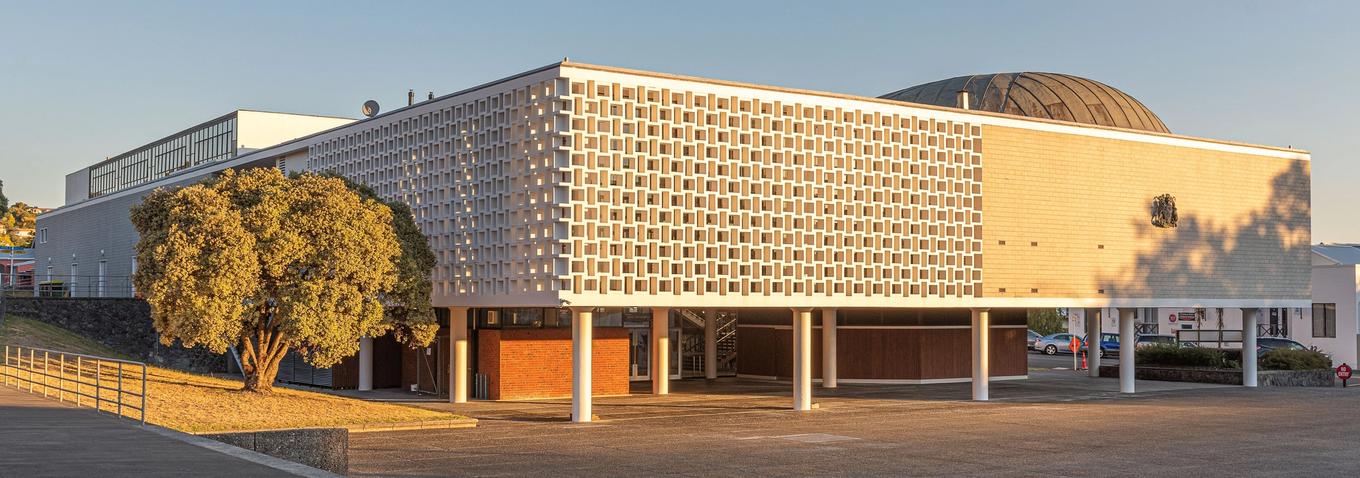
When the Whanganui War Memorial Centre was built in the late 1950s, though officially opened on ANZAC Day 1960, it was radical, a remarkably advanced design decision for a regional city like Whanganui, with its legacy of classical and colonial architecture. Building something as modern as the War Memorial Centre was a very brave move. And probably polarising at the time.
It’s still stunning. It’s often the first thing people comment on when they hear I’m from Whanganui. For the architectural community, it’s a seminal building in New Zealand’s design history.
To be appointed lead architect on the earthquake strengthening of the building was a huge honour. The need to preserve the architectural integrity of the building was paramount and initially seemed like an insurmountable task.
The building’s design didn’t leave a lot of room to hide, so it took a bit of risk and lateral thinking to come up with the right solutions. There were no timber walls or ceiling spaces to hide interventions. Everything had to be carefully considered so that it didn’t impinge on the experience or quality of the building, externally or internally.
We were able to work with local structural engineers who understood the building including the need to maintain the integrity of the piloti or columns, which created the sense of the building floating across the forecourt.
Today, I know there’s an extension built under the piloti, but most people would have no idea. We very carefully considered our interventions and kept things proportionally right. There were some spaces in the building, like the Pioneer Room, that were sacrosanct, so we opted to put our new structural interventions in the Concert Chamber next door, largely hidden under the tiered seating. While there are two new visible columns in the main foyer, the rest of the new structure went into the main hall, where large-scale interventions could be better accommodated.
We also developed solutions for accessibility and energy efficiency. It was a challenge but rewarding when people say they can’t see where we’ve been or what we’ve done.
Working on heritage architecture is not about ego – it’s about doing the best for the building. With the War Memorial Centre, it wasn’t about me but about ensuring the building’s legacy. It was a huge privilege, and it’s nice to walk past and know I’ve had a hand in preserving that building for future generations.
Check out more from BSM Architects: bsmgrouparchitects.co.nz